
 As students move up through the clusters at Stephen Gaynor School, what they learn becomes more complex and progresses to match their age and maturity as they prepare for high school and beyond. However, one thing remains constant: the individualized approach to each child’s education.
We wanted to answer the question: “What does an individualized education look like in Gaynor’s Middle School?”
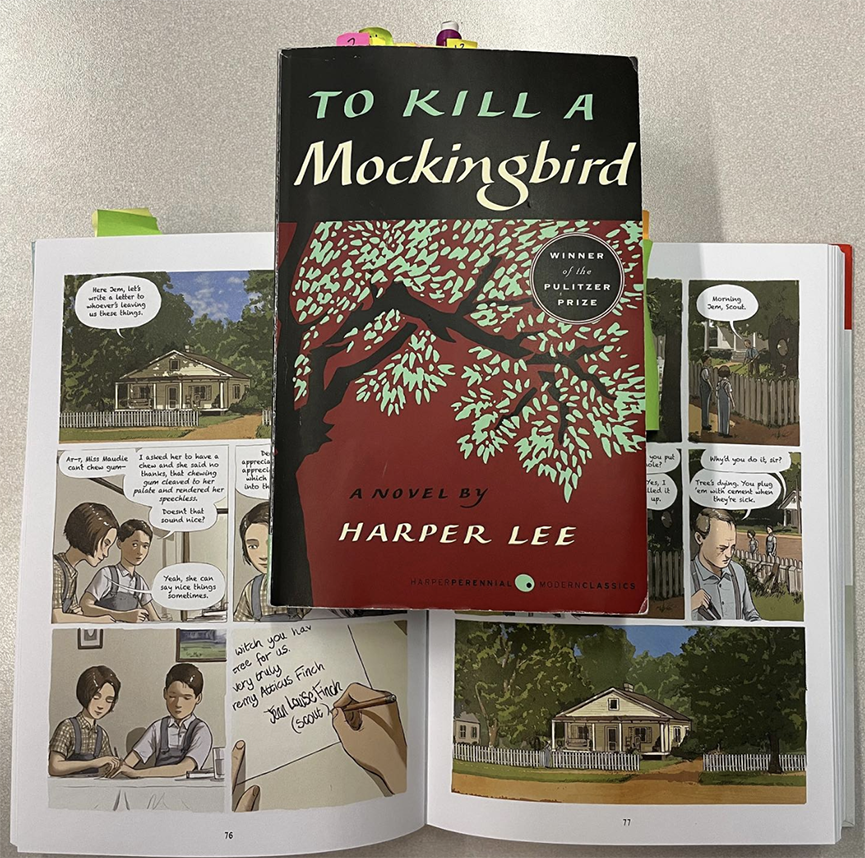
A good example are a pair of Dark Blue Cluster reading groups, which are reading To Kill A Mockingbird by Harper Lee. The book explores the themes of loss of innocence, courage, and bravery.
Blue Cluster Head Teachers Adalake Barnwell and Jody Buckles are both reading the novel with their students. Both of them said they use techniques such as annotating, playing the audiobook, and utilizing visuals to help students navigate the text.
“We’re hoping to help the kids at this phase move into analyzing literature more deeply,” Ms. Barnwell said. “We have a routine in class where we’ll take one really rich passage and read it three times with different colored pens. This is my way of sort of breaking down for the kids what process they should eventually be taking.”
She said the students read first for any vocabulary they don’t know. They then read again to look for parts of the passage that are connected to other parts of the book. Finally they read to find the author’s language.
Ms. Barnwell said, “In homework, the kids’ job is to find one quote that stood out to them and bring that to the class for discussion, so that kind of allows the kids individually to pick up on what they notice, so some students will notice something that’s really just an interesting plot development or that’s just an interesting trait of a character. Other kids will say I noticed this, and I think it’s symbolism, or I noticed this and it’s really important imagery. By sort of giving them the freedom to pick up on what’s interesting to them, they’re finding different things, and we’re able to weave all of that into the discussion.”
In Ms. Buckles’ class, students worked on building their background knowledge before diving into the reading. They learned about the different dialect and vocabulary used, as well as the time period the book takes place in (the Great Depression), the area (Alabama), and Jim Crow era laws.
“I wanted to bolster them as much as I possibly could before we even began,” Ms. Buckles said. “Then, once we established all of that, that’s when we got into it.”
Looking around her room, images of characters from the book are taped all along the whiteboards. This is because her group of students consists of many visual learners.
“I started to notice pretty quickly that my students really needed some visuals to help them better understand what’s happening in the story,” she said. “Once we got a graphic novel of the book for everyone, they started to reference it more, and there were a lot of, ‘aha’ kind of moments in the classroom like, ‘oh, I see who that is and what’s going on.’”
Ms. Buckles said after her class finishes hearing all of the testimonies from the trial in the novel, her goal is to have students watch that part in the movie adaptation.
“I find that it follows along quite well,” she said. “Being able to connect the visual from the movie that exists to the story I think makes a big difference and helps them.”
Ms. Barnwell said that while they do focus on the literary side of things, such as looking at motif and symbolism, she also wants her students to take into account the social historical human nature part.
“That’s what I most want them to understand,” she said. “Let’s look at these people and all the ways that racism is functioning and coming together in the trial.”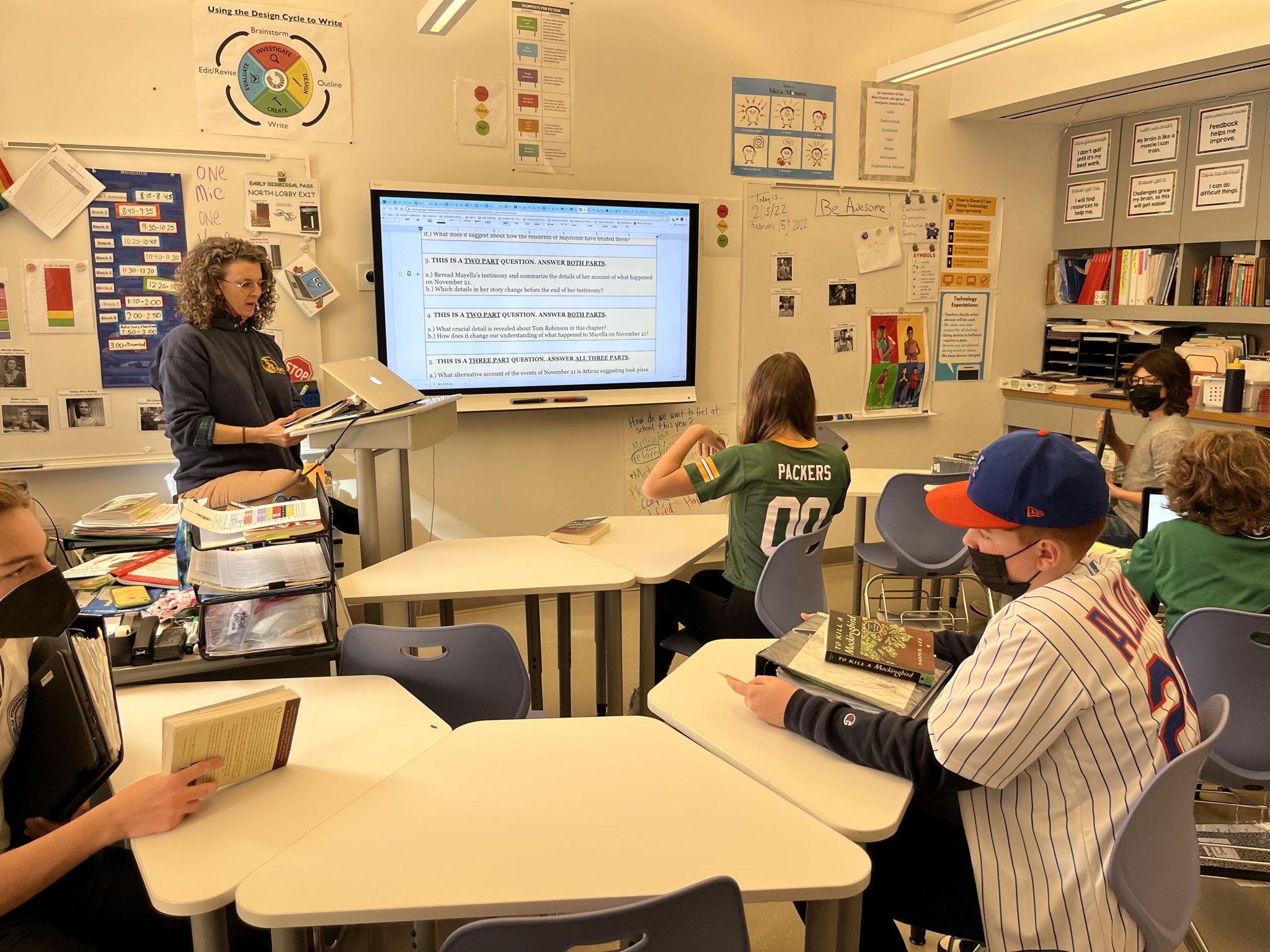
Ms. Buckles agreed and mentioned that the current Blue Cluster Diversity, Equity, and Inclusion Curriculum ties in well with the novel, saying, “It feeds into this so well because we can take from there what we’ve learned about race or identity or things of the same nature.”
Ending the discussion, Ms. Barnwell said she recommends parents consider rereading To Kill A Mockingbird themselves.
“I read it when I was in 9th grade, and there’s so much that I missed,” she said. “Especially if you’ve seen the movie or the play. They’re both beautiful, but I think one of the most amazing things about this book are all the small characters. We all remember Atticus Finch, but I think Harper Lee has such an amazing skill at drawing these minor characters, and it really reveals so much about how racism functions in American society, and I missed it all in 9th grade.”