
How Restorative Circles are Shaping Community at Stephen Gaynor School
When Dr. Scott Gaynor talks about the future of Stephen Gaynor School, he often returns to a simple idea: a thriving learning environment depends on a thriving community.
“I see our school as a restorative environment,” he said, reflecting on the school’s ongoing efforts to strengthen belonging and connection.
That philosophy is now taking shape through the school’s evolving restorative practices initiative, a multi-year effort rooted in the belief that conflict is a natural part of human experience and that students flourish when relationships come first. This shift is not a new discipline system. It is a cultural evolution that deepens Gaynor’s individualized, relationship-based approach by giving students structured ways to build empathy, express their needs, understand the needs of others, and make amends when harm occurs.
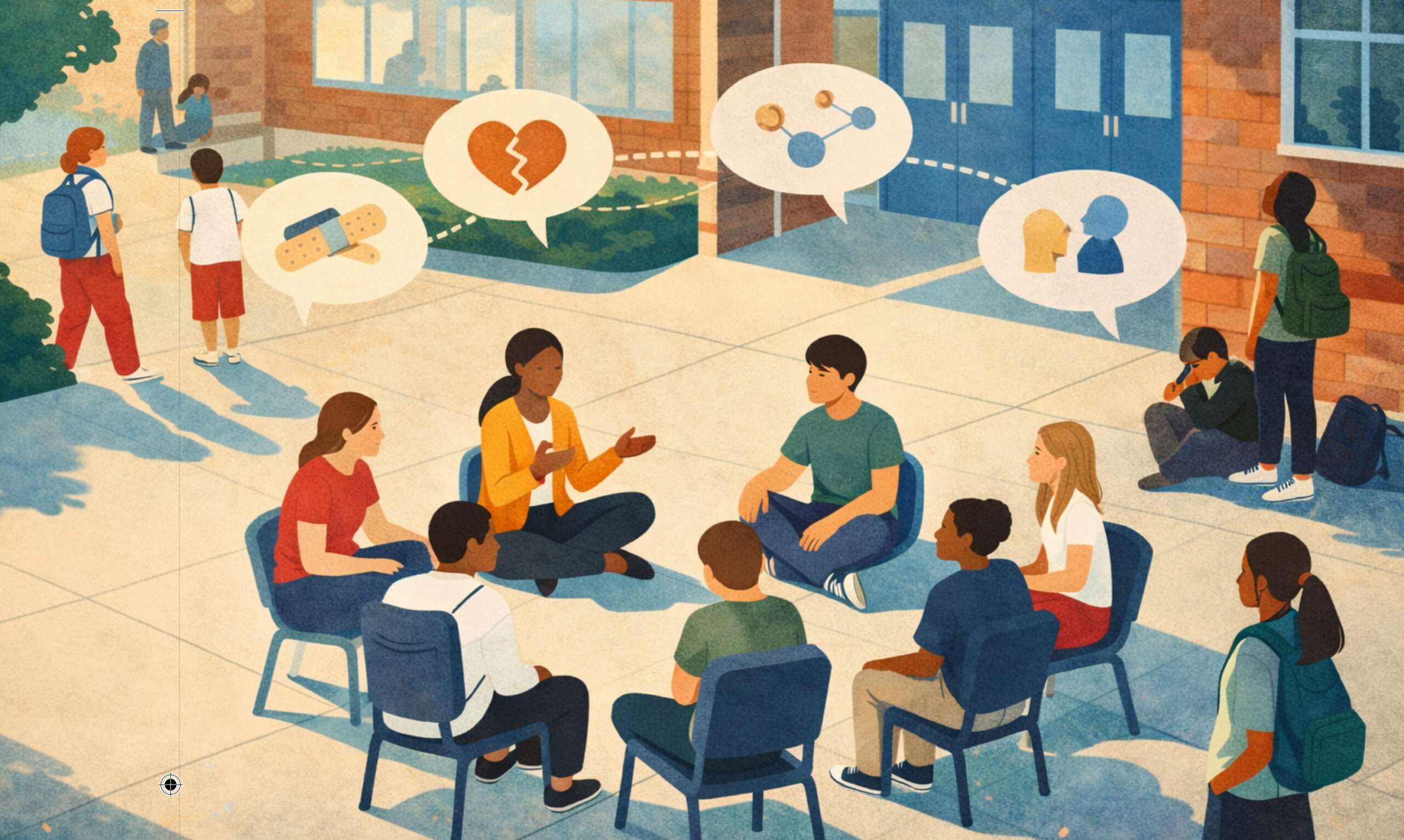
The catalyst for this work came into focus over time. Teachers were asking for more tools to respond to conflict in a developmentally attuned way. Families expressed a desire for greater clarity around the school’s approach to communication, consequences, and community expectations. And staff across divisions noticed a rising need for shared strategies to support inclusion and reduce non-inclusive behaviors.
As Stella Heyliger-Mulatu explains, “We needed a framework that aligns with who we are. Restorative practices offer a child-centered, dignity-based way of helping students learn, reflect, take accountability, and grow.”
The heart of this work appears in classrooms through restorative circles, small group conversations that give students a structured opportunity to connect, reflect, and listen. Circles can be brief and lighthearted, or they can offer space to process challenges together. What they share in common is purpose: they help students learn how to connect with one another, build trust over time, and develop the skills needed to repair relationships when conflict arises.
In Rebecca Felt’s Intermediate Division, circles are becoming part of the rhythm of school life. She has watched students enter the awkward phase of sitting in a circle and making eye contact, then gradually settle into the routine.
“Our kids benefit from structure,” she explained. “Just like there are structures for learning math or writing, circles give structure to how we talk to each other. And that structure allows students to connect in ways that feel safe and predictable.”
Those small developments matter. The intermediate years are a time when students look increasingly to peers for cues, affirmation, and social guidance. Circles meet them exactly where they are developmentally, giving them a space to practice perspective taking and clear communication, two of the social-emotional capacities Gaynor explicitly teaches.
This year, Ms. Felt has seen a noticeable shift. Circles that began with fidgeting and giggles have grown into conversations where students share honestly and listen with more focus. Teachers are finding that these practices help create classrooms where differences are respected and where students feel more grounded and ready to learn.
One of the most resonant examples she shared happened during an ordinary morning circle.
“A quieter student who’s been building confidence raised her hand and decided to share how she was feeling. The whole class listened. It was simple and beautiful, and it reminded me exactly why we’re doing this.”
From the clinical perspective, restorative circles and restorative conversations are more than community-building tools. According to Dr. Marc Guttman, they help lay down the emotional and cognitive skills that students need far beyond middle school.
“At their core, restorative practices teach empathy,” he said. “Perspective taking is one part, but empathy is being able to understand someone else’s feelings as well. When students build those capacities early, it affects how they navigate friendship, conflict, and community throughout their lives.”
Dr. Marc collaborates closely with faculty on the RULER blueprint, a structured conversation tool used throughout Gaynor. He sees a natural connection between RULER work and circles. Circles create the baseline of connection; RULER helps students address harm when conflict arises. Together, they provide a language and a framework for understanding intention, impact, and next steps.
He shared that he has seen students become more able to reflect on their own choices, recognize how someone else may have felt, and articulate what they need going forward. In some cases, students even take the initiative to repair harm on their own.
“When a child chooses to apologize without being prompted because they’ve genuinely understood another person’s experience, that is meaningful growth,” he said.
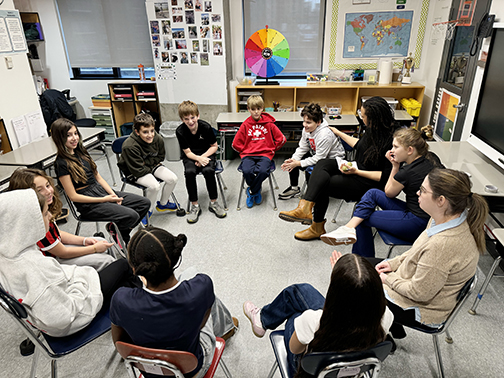
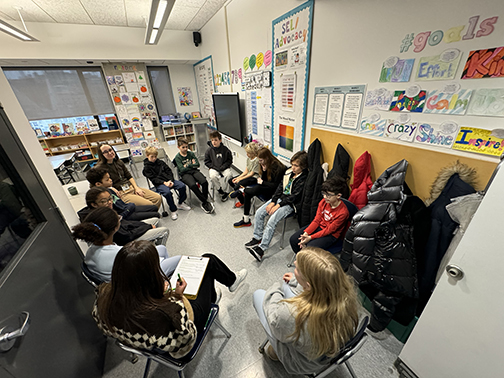
In the Green Cluster, Head Teacher Jacinta Capelli uses circles regularly, often as brief ten-minute openings that set the tone for the day.
“Each time, I learn something new about a student,” she said. “Middle schoolers have such thoughtful perspectives…”
For Ms. Capelli, restorative practices strengthen the relationship between teachers and students by building a foundation of trust and mutual respect. She sees circles as a natural extension of Gaynor’s small-class model.
“We already value knowing each child deeply. Circles just give us another way to help students feel seen and heard.”
What she hopes families understand most is that circles are not just about social skills but also about learning.
“When students feel comfortable and connected, they participate more. They take more intellectual risks. It affects their academic growth in ways that are really powerful.”
Across the school, restorative practices are still in an early phase. This year, teachers received circle scripts to try, employees participated in facilitated adult circles to experience the model themselves, and administrators engaged in advanced training. Next year, proactive community-building circles will expand further, supported by a full teacher training series.
The goal is not perfection. It is steady cultural alignment.
As Ms. Mulatu often reminds the community, “Restorative practices are not about avoiding conflict. They help us approach conflict as something human that we can learn from. They help us build a school where accountability comes with dignity and where every student feels a sense of belonging.”
Dr. Gaynor sees this evolution as essential to the path forward.
“Our mission has always been to meet students where they are. Restorative practices extend that philosophy to the social and emotional lives of our children. They help us create a community that supports learning, growth, and connection for every student.”
At Gaynor, restorative circles are becoming a quiet but transformative part of the school day: an invitation to speak, to listen, and to understand one another more deeply. In that sense, they reflect the community Gaynor strives to build every day: a place where every voice has value, and where every challenge is an opportunity to grow.